


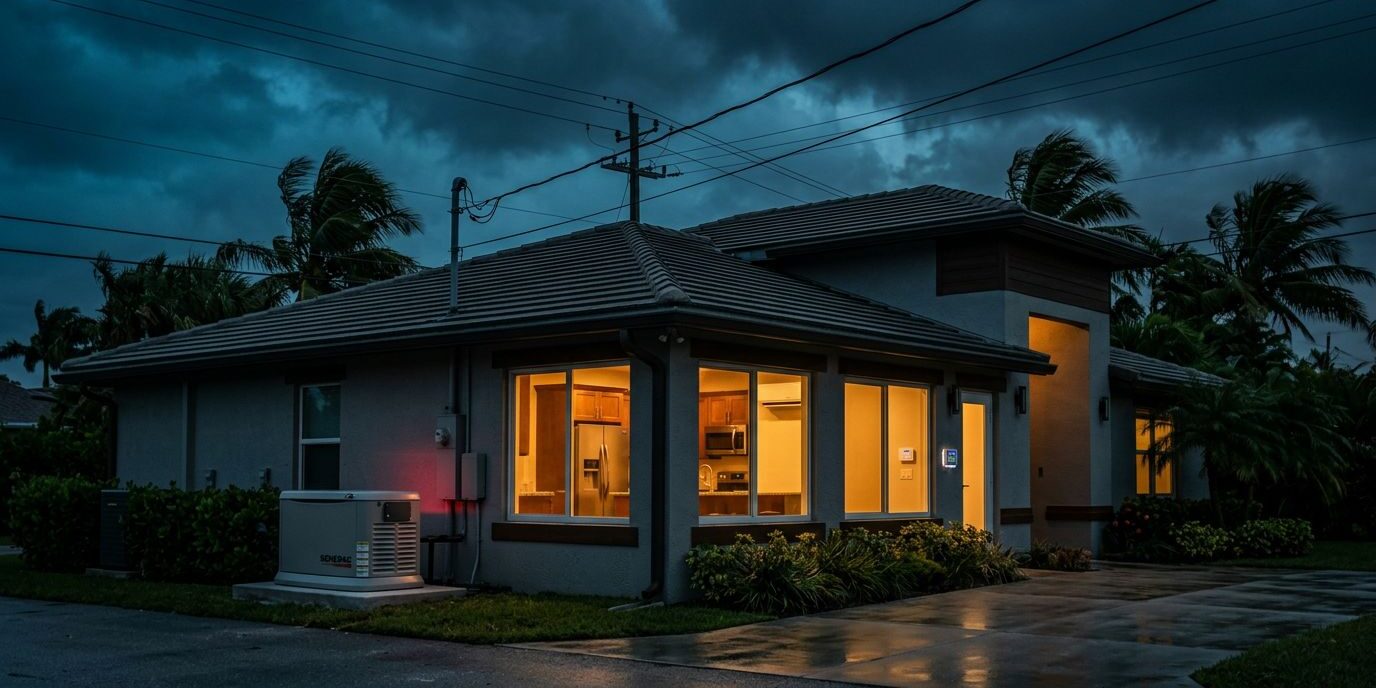
Too small, and your generator may stumble when the air conditioner starts. Too large, and you pay for power you may never use.
Good whole house generator sizing starts with your real electrical load, rather than your home’s total square footage. While many homeowners assume that larger properties require massive units, your actual backup power needs depend on which appliances you must run at the same time. For residents in Southwest Florida, this means planning for humidity control, heavy storms, and outages that can last much longer than a quick flicker. The right generator size comes down to identifying exactly which circuits are essential for your comfort and safety.
Key Takeaways
- Prioritize Based on Need: Generator sizing should be dictated by the appliances you absolutely require during an outage, such as the refrigerator, AC, and security systems, rather than your home’s total square footage.
- Understand Surge Wattage: Motors in heavy appliances like air conditioners and well pumps require a temporary “surge” of power to start, which can significantly impact the total generator capacity needed.
- Use Load Management: Intelligent load shedding allows you to manage large appliances by cycling them, which can help a smaller, more efficient generator unit power a larger home without overloading.
- Professional Assessment Required: Always consult with a licensed electrician to conduct a formal load calculation based on your home’s actual equipment nameplates and electrical panel to ensure safe and reliable performance.
Start with the loads you need during an outage
A home standby generator is different from portable generators in one big way. It is installed in place, tied into your home’s electrical system, and starts automatically when utility power drops. Many systems run on natural gas or propane, which is helpful during long outages, and they are usually quieter than portable units because they sit in sound-reducing enclosures.
That does not mean every standby system should power every single thing in your house. The first step is deciding what you want to stay on during an emergency.
For most homes, the priority list starts with the basics. That often includes the refrigerator, freezer, lights, internet, garage door, and a few outlet circuits. In Southwest Florida, at least one air conditioning unit is also high on the list because heat and humidity can make a home miserable fast. Some homes also need a well pump, medical devices, a security system, or a pool control system.
A few loads are easy to live without for a day or two. Pool heaters, second ovens, electric dryers, and the electric vehicle charger usually fall into that group. You can still include them, but each added load pushes the generator size up.
Square footage helps only a little. Two homes with the same floor plan can have very different power needs. One may have gas cooking and a gas water heater. The other may run both on electricity. One home may have a single 3-ton AC unit. Another may have two larger systems plus a well pump.
A generator should be sized for what may run together, not for every device you own.
That is why exact sizing should be based on your home’s actual electrical loads. A licensed electrician or generator installer can review your electrical panel, equipment nameplates, and usage patterns, then turn that into a real number you can trust.
Watts, surge wattage, and the numbers that trip people up
Generator sizing becomes much simpler once you understand the difference between running wattage, which is the constant power an appliance needs to function, and surge wattage, which is the temporary burst required to start equipment.
Running watts represent the power an appliance uses while it operates normally. Surge wattage, also known as startup power or startup watts, is the extra energy some equipment needs for a few seconds when it kicks on. Electric motors create the most significant power spikes. This category includes air conditioning units, refrigerators, freezers, well pumps, pool pumps, sump pumps, and furnace fans.
A generator rated at 22 kilowatts can supply about 22,000 watts. While that is a substantial amount of power, the startup power required by various motors can quickly consume your capacity if too many units activate at the same time.
Here are rough estimates to help you gauge your needs. Actual ratings vary by brand and model, so use these figures only as a starting point.
| Appliance or system | Running watts | Startup power |
|---|---|---|
| Refrigerator | 600 to 800 | 1,200 to 2,000 |
| Well pump | 1,000 to 2,000 | 2,000 to 4,000 |
| Sump pump | 800 to 1,200 | 1,500 to 2,500 |
| 3-ton central air conditioning | 3,000 to 4,000+ | 6,000 to 9,000+ |
| Furnace fan | 500 to 800 | 1,000 to 1,500 |
| Microwave | 1,000 to 1,500 | Small or none |
Homeowners are often surprised by the power demands of air conditioning. An air conditioning unit might run comfortably within the generator’s limits once it is active, but the compressor requires a massive surge to initiate the cycle. The same principle applies to pumps and heavy-duty fans.
Meanwhile, lighting and small electronics represent relatively modest loads. LED lights, TVs, phone chargers, and routers barely move the needle compared to high demand appliances like air conditioning, ovens, clothes dryers, or water heaters.
The most accurate way to size a system is to check the nameplate data on each major load. Your installer may also use a professional power calculation, panel review, or monitoring tools to measure your actual energy demand over time.
“Whole house” doesn’t always mean everything at once. It often means the home functions normally because the largest loads are planned well.
Once you understand watts and surge demand, the next piece of the puzzle is deciding which appliances can run simultaneously and which ones need to take turns.
How load management and transfer switches change the answer
The transfer switch is the critical component that moves your home from utility power to generator power. In a home standby generator setup, this process happens automatically. The transfer switch also prevents generator power from feeding back into utility lines, which is a vital safety requirement.
The switch matters because it helps define exactly what the generator will carry. Some systems back up the entire service entrance, while others feed only selected circuits. Regardless of the configuration, the transfer switch does not create more power; it simply directs the power you already have.
Load management is where sizing gets smarter. If your generator is close to the peak demand of your home, a load management controller can prevent an overload by holding off large, nonessential devices. Through a process called load-shedding, the system might pause an electric water heater for a few minutes while the AC compressor starts. You likely will not notice the difference, but the generator will.
This is one reason a 22 kW or 24 kW generator can work effectively in a home that seems larger on paper. If the system manages the biggest loads efficiently, you may not need a much larger unit. However, if you want two AC systems, an electric range, a dryer, and a pool pump to run simultaneously, you will need significantly more capacity.
A proper whole house generator installation includes much more than just picking a kilowatt number. It involves careful transfer switch planning, electrical panel work, permitting, and startup testing. It also requires a thorough fuel supply check, as your generator needs a consistent flow of natural gas or propane to perform reliably.
Compared with the hassle of portable generators, a standby system is far easier to live with during a storm. You do not have to wheel equipment outside, manually refuel with gasoline every few hours, or run extension cords across the garage. That professional installation and long-term convenience are the primary reasons many Florida homeowners choose standby power for true whole-home backup.
Real sizing examples for Southwest Florida homes
Most residences do not require a giant commercial unit. Still, many homeowners need more power than a small portable unit can handle. In practice, the ideal home standby generator often lands in the mid-teens to mid-20s range for kilowatts, though larger homes with multiple cooling systems may require significantly more power.
Smaller home, lighter electric load
A smaller home or condo with one air conditioning system, gas cooking, and gas water heating may fit in the mid-teens range for kilowatts if you are backing up selected loads. That setup might cover essential lighting, refrigeration, internet connectivity, select outlets, your garage door, and a single cooling system.
Mid-size home with one central AC
A typical single-family home in Fort Myers, Naples, or Cape Coral often requires a unit in the low-20s range for kilowatts if the goal is to keep the house comfortable during an outage. If your property includes a well pump, additional kitchen appliances, or more extensive circuit coverage, that number can climb quickly.
Larger home with two AC systems
A larger home with two central air conditioning units, electric water heating, heavy kitchen equipment, and comprehensive circuit coverage may need a unit in the upper-20s range for kilowatts or beyond. At that power level, managing surge demand and fuel supply becomes even more critical.
These scenarios are only examples, not formal quotes. The final answer depends on your home’s actual equipment, your daily habits, and which appliances you prioritize during a storm. A licensed electrician should always confirm your specific load requirements before you purchase a system.
There is another factor homeowners often overlook: upkeep. A standby generator is your safety net for difficult days, so it must be ready before the storm arrives. Regular whole home generator maintenance is essential because oil levels, battery condition, filters, and test cycles all determine whether the unit starts when you need it most. We recommend working with a local dealer for professional installation and ongoing service to ensure your system is always storm-ready. Many modern units also run weekly self-tests and support app-based alerts, which provides extra peace of mind as hurricane season approaches.
Frequently Asked Questions
How is running wattage different from surge wattage?
Running watts refer to the power an appliance consistently draws while operating normally. Surge wattage, or startup power, is a temporary, higher spike of energy required for a few seconds to start electric motors found in devices like AC units, refrigerators, and pumps.
Do I need to power my entire home at once?
Not necessarily. While you can choose to back up every circuit, many homeowners use transfer switches and load management to prioritize essential comfort items and cycle large appliances, allowing them to use a smaller, more cost-effective generator.
Why can’t I just use my home’s square footage to pick a generator size?
Square footage does not account for the specific equipment inside your home, such as whether you have gas versus electric appliances or how many high-demand HVAC systems you operate. Two identical homes can have vastly different power requirements based on their internal systems and your personal usage habits.
What is load shedding and why does it matter?
Load shedding is a feature of smart transfer switches that prevents your generator from overloading by temporarily pausing large, non-essential devices when power demand is high. It ensures your most critical systems, like medical equipment or refrigeration, always receive power even when other high-draw appliances attempt to cycle on.
Conclusion
The right generator size comes from your home’s real demand, not a guess based on square footage or a neighbor’s setup. Watts, surge wattage, transfer switches, and load management all shape the final number. Ultimately, the best way to meet your backup power needs is through a custom assessment rather than an estimate.
For most Southwest Florida homeowners, the smart move is to decide what must stay on, then have a licensed electrician confirm the load with your actual equipment. By consulting a professional, you can select the right home standby generator for your property, ensuring you have a system that fits your specific needs, your comfort level, and your outage plan.
If you want a firm size range for your house, Get a Free Consultation.