


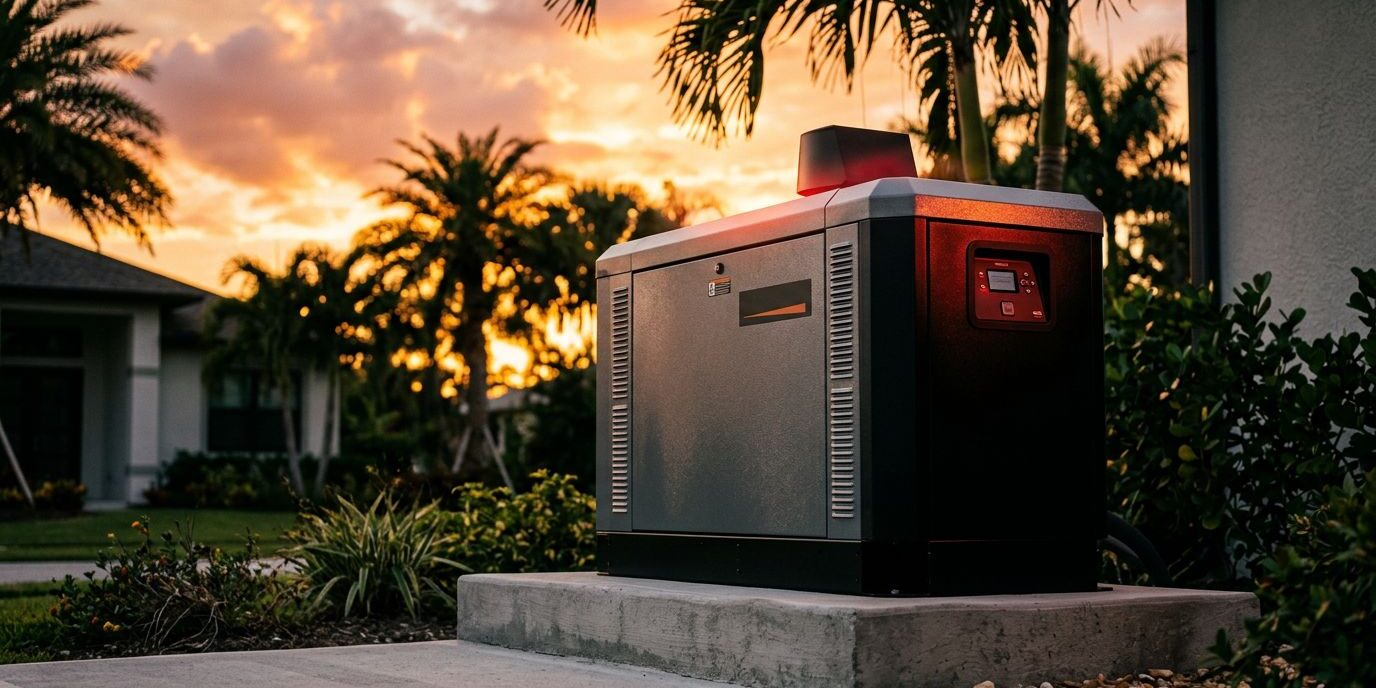
A standby generator can save your food, your AC, and your patience. Providing reliable emergency backup power is essential in our climate, but in Florida, the better question is this: how long will the system keep showing up when the lights go out?
My short answer is simple. A well-kept whole house generator often lasts 10 to 20 years in Florida, but the calendar only tells part of the story. Heat, salt air, storm run time, and maintenance usually decide whether you get the long end of that range or the short one.
If you want a clear read on whole house generator lifespan, start with how Florida treats outdoor equipment.
Key Takeaways
- Lifespan Expectations: In Florida, a well-maintained standby generator typically lasts between 10 and 20 years, depending heavily on usage and environmental factors.
- Environmental Impact: Florida’s heat, humidity, and salt air significantly accelerate corrosion and wear, making proper location and protection from elements critical for longevity.
- The Role of Maintenance: Regular servicing—including oil changes, filter replacements, and load testing—is the most effective way to prevent premature failure and ensure the system functions during emergencies.
- Usage Patterns Matter: Extended run times during hurricane seasons add more mechanical stress than routine weekly exercise cycles, necessitating post-storm inspections to catch hidden damage.
- Signs of End-of-Life: Frequent, recurring repairs, advanced corrosion, and difficulty starting under load are clear indicators that it may be more cost-effective to replace the unit rather than continue maintenance.
What kind of lifespan should you expect in Florida?
If you ask me for a straight number, I start with 10 to 20 years as the typical life expectancy for most residential standby units. Some systems make it past that, while others start costing too much to keep around sooner. The difference usually comes down to use, care, and conditions.
A stationary generator ages more like a truck than a lamp. Your specific usage patterns matter significantly here. A unit that runs a short weekly exercise cycle and only a few outage hours each year may have a lot of life left after a decade. Another unit the same age might have spent days running through storm outages and be far more worn.
That matters in Southwest Florida. In Fort Myers, Naples, Cape Coral, Bonita Springs, and Lehigh Acres, generators do not live an easy life. They sit outside in heat and humidity, then get called into action during the worst weather of the year.
Here is the simple way I frame it:
| Situation | What it usually means for generator life |
|---|---|
| Light use with regular service | Often lasts longer |
| Frequent power outages | Adds engine wear faster |
| Salt exposure near the coast | Speeds up corrosion |
| Missed maintenance visits | Shortens service life |
| Proper sizing and clean installation | Reduces strain over time |
The takeaway is clear. Whole house generator lifespan is not only about age. It is about hours, environment, and upkeep.
What wears a whole house generator out faster in Florida?
Florida has a few bad habits, and your generator faces all of them at once. Heat bakes components, humidity invites corrosion, and coastal air brings salt. Storm season pushes your usage higher when the unit is already working in harsh conditions. Unlike a portable generator that can be stored in a garage between uses, a stationary unit is constantly exposed to the elements.
In Florida, age alone does not wear a generator out. Harsh environmental conditions, salt air, long run hours, and skipped service are the real culprits.
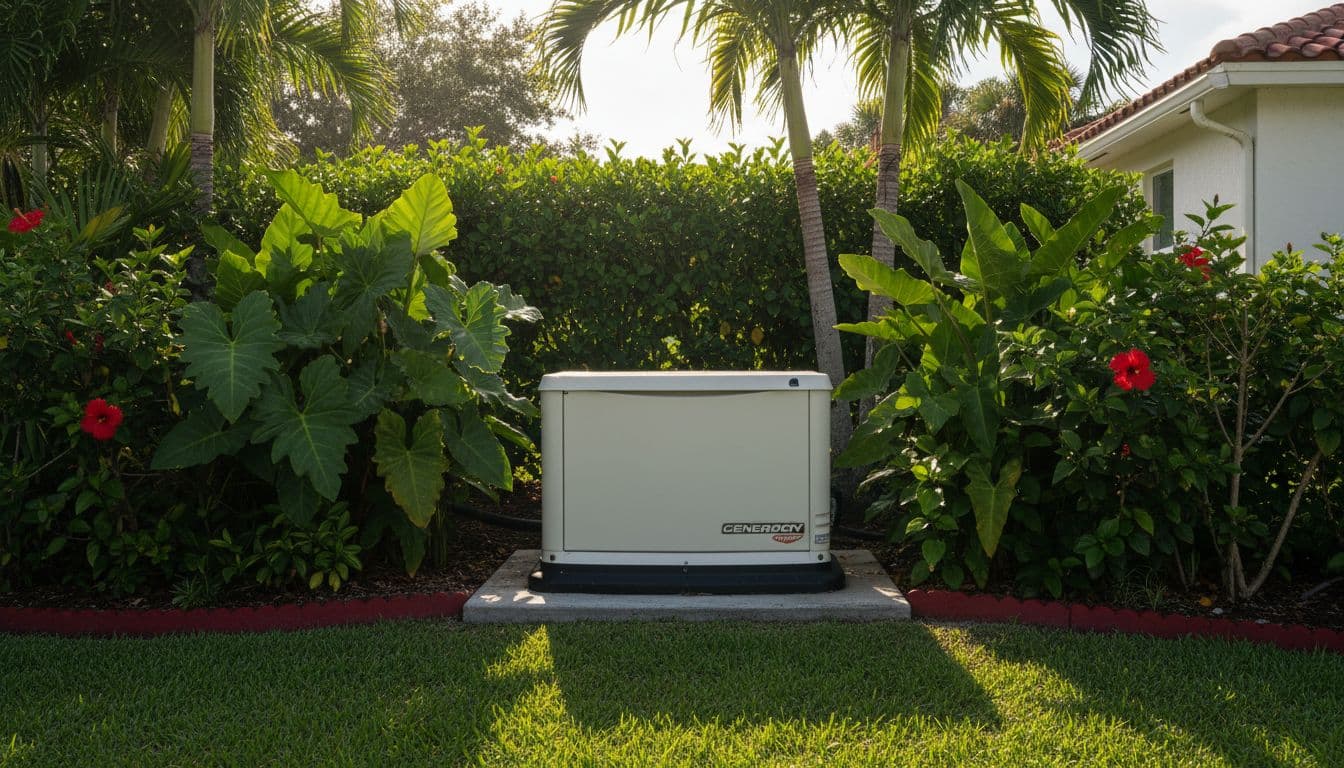
A clean, dry installation gives a standby unit a better shot at a long life.
Salt air is one of the biggest troublemakers. Even when you are not right on the beach, coastal moisture can slowly eat away at metal parts, fasteners, enclosures, and electrical connections. Over time, this corrosion infiltrates the internal components of the system. Rust rarely shows up all at once. It creeps in, then one day a panel looks rough, a connection looks tired, or the enclosure does not close quite right.
Placement matters too. I see problems when a generator sits in a spot with poor drainage, packed vegetation, or constant sprinkler spray. Water where it should not be is bad news. So is restricted airflow. A generator needs room to breathe, especially when it is carrying a heavy house load in August.
Storm run time also changes the picture. A weekly exercise cycle is one thing, but logging significant operating hours after a hurricane is something else. That is real engine time, and the accumulated wear and tear from extended running hours can take a toll on the system. After Hurricane Ian, plenty of homeowners around here saw the value of a generator that was installed right and maintained well. They also learned that a hard-working system needs a post-storm check, not just a pat on the lid.
Another killer is a mismatch in sizing. If a unit is undersized for the home load capacity, it works harder than it should. If fuel pressure is off, it may struggle to start or run cleanly. If the battery is weak, the starter works harder. None of these issues look dramatic at first, but they stack up.
Then there is the simple one people forget: no maintenance. A standby system is not a lawn ornament. It is an engine, a transfer switch, a battery, filters, fluids, sensors, and controls. Ignore those long enough, and the lifespan drops.
What helps a whole house generator last longer?
A long lifespan begins with a professional installation. I do not just mean a clean aesthetic setup. I mean the practical details that prevent future trouble, such as proper sizing, solid electrical work, a correct fuel setup, stable mounting, good drainage, and enough clearance around the unit.
This coordination matters more than most homeowners realize. A whole-home generator install often involves electricians, permit steps, inspections, and fuel lines. Whether you rely on natural gas, propane generators, or diesel generators, the fuel type and quality of the setup dictate how well the unit ages. When that part is sloppy, the unit may still run, but it will not last as long as it should.
Routine maintenance is the next piece, and it is the one that pays off year after year. Regular oil changes and replacing air filters are essential for internal health. Battery checks, load testing, connection inspections, and software reviews are equally important for catching small issues before they become major repairs. If you want professional generator maintenance services, remember that scheduled visits are far cheaper than surprise failures.
I also recommend utilizing an exercise mode and remote monitoring. Many standby systems can self-test on a schedule, and some allow you to track status through an app with web, text, or email alerts. That is not just a convenience feature. It helps you catch faults early, especially if you split time between homes or travel during storm season.
If you are not sure how often service should happen, this whole home generator maintenance schedule gives a useful baseline. The exact timing depends on the specific model, the fuel type, and how many total hours the unit has run.
A few habits make a real difference:
- Keep the area around the generator clear.
- Do not let sprinklers soak the enclosure.
- Schedule service after long outage runs.
- Pay attention to alerts instead of silencing them and moving on.
I also tell homeowners to think past the machine itself. The best standby generator in the world will not last as expected if the fuel supply is unstable or the electrical load is unrealistic. A smart setup protects the unit every time it starts.
If your system is overdue for service, showing signs of corrosion, or you are planning ahead for the next storm season, Get a Free Consultation and get a clear read on its condition.
Signs your generator is getting close to the end
Generators rarely quit with one dramatic speech and a puff of smoke. Most of the time, they start dropping hints.
Hard starts are one hint. Repeated alarms are another. So is rough running during the weekly exercise cycle. If the generator struggles under load, hunts for steady speed, or shuts down when the house needs it most, something is wearing out.
Corrosion is a big one in Florida. If I see rust spreading across the enclosure, hardware, or internal components, I pay attention. The same goes for brittle wiring, exhaust issues, oil leaks, coolant problems on liquid-cooled models, and a battery that seems to be on borrowed time every season. Consistent annual inspections are the best way to catch these issues before they become permanent damage.
Repair history matters too. One repair is not a crisis. A pattern is. When service calls start bunching up, parts get harder to find, or the same fault returns, the math changes. At some point, you are not extending generator life. You are nursing an old machine through one more summer.
Age still counts, but not in a simple way. A 7-year-old unit that ran through an extended outage during a major hurricane can be more worn than a 15-year-old unit with light use and steady care. That is why I look at the full picture, including age, operating hours, service records, corrosion, and how the unit behaves under load.
The transfer switch matters too. Sometimes the engine is fine and the switching equipment is the weak spot. Other times the opposite is true. A good inspection sorts that out fast.
If you are wondering whether to repair or replace, I start with three questions. Is the backup power system still dependable under real load? Are repair costs staying reasonable, and is the fuel efficiency still acceptable compared to modern standards? Are parts still available without a long wait? If two of those answers go the wrong way, unit replacement starts to make more sense.
Frequently Asked Questions
Does Florida’s climate really change how long a generator lasts?
Yes, the combination of high humidity, intense heat, and salt-laden coastal air can significantly accelerate rust and component fatigue. Unlike regions with milder weather, Florida units face constant exposure to conditions that degrade metal enclosures and electrical connections much faster than those stored in drier, climate-controlled environments.
How often should I have my generator professionally serviced?
We recommend following a consistent maintenance schedule, typically at least once a year, or after any period of extended operation during a major power outage. Regular visits ensure that fluids, filters, and electrical components are functioning correctly before you find yourself in an emergency situation.
Can I just use my generator for the weekly self-test and ignore it otherwise?
While the automated exercise cycle is a great feature for keeping the engine lubricated, it is not a substitute for professional hands-on inspection. A technician can identify issues like battery depletion, minor oil leaks, or early signs of corrosion that an automated test might not detect until the system fails under a full house load.
At what point should I stop repairing an old unit and just replace it?
When repair costs begin to stack up or you find that the same faults return repeatedly, it is often more economical to replace the unit. If parts become difficult to source or the generator can no longer handle your home’s power demand reliably, it is time to consider a modern, more efficient replacement.
Final thoughts
Achieving a long whole house generator lifespan in Florida is possible, but it is never automatic. The homes that get the best years out of a standby system usually follow the same pattern: professional installation, regular maintenance, a clean fuel supply, and fast attention whenever the system begins acting up.
I would not judge a generator by age alone. Instead, I would judge it by how it has lived. In Florida, the history of its care and operation tells the truth about its remaining utility far better than the model year ever will.