


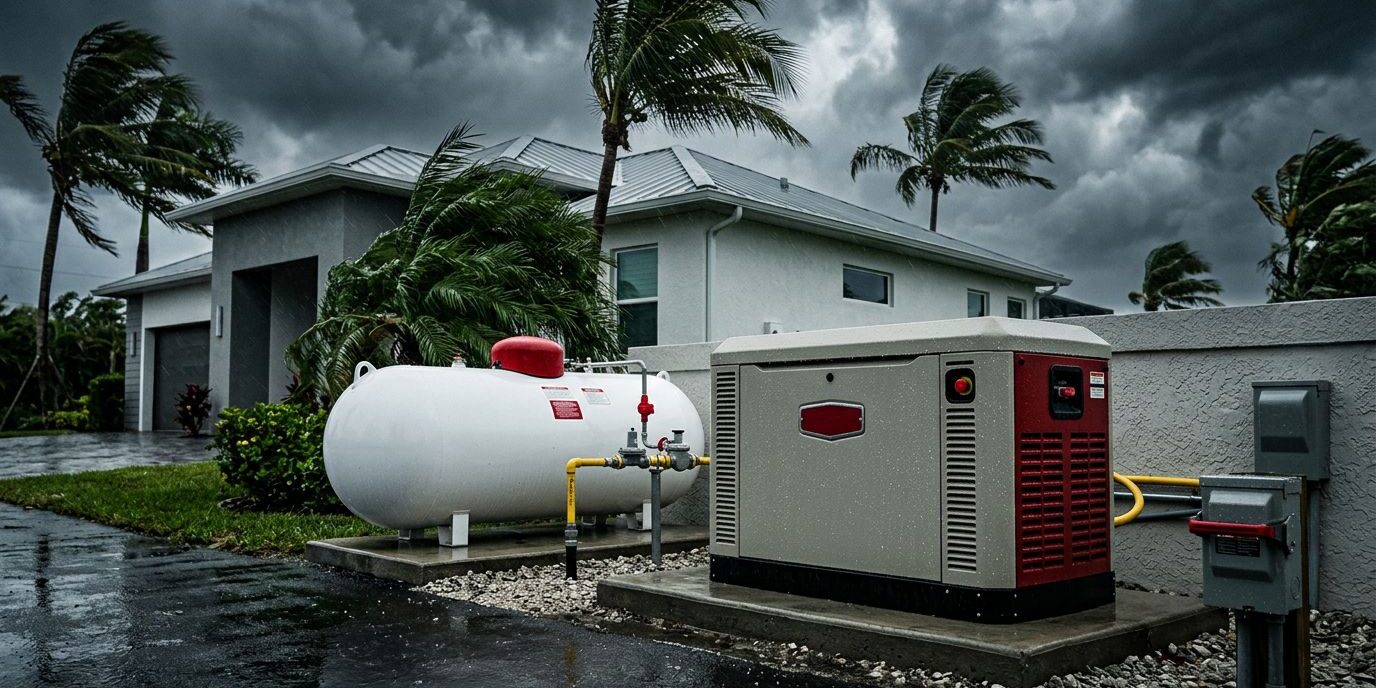
A standby generator can keep your Southwest Florida home comfortable during a storm, but the fuel supply must last as long as needed. Propane tank sizing depends on fuel consumption, connected loads, outage length, and propane delivery difficulty after a hurricane.
A 250-gallon tank may meet the minimum for some residential systems, but the tank size may not provide enough runtime for a large home with central air conditioning, pool equipment, and other major loads. We recommend planning for real outage conditions, not just normal weekly testing.
Key Takeaways
- Propane tank sizing should be based on usable gallons, generator fuel consumption, connected loads, and the expected outage duration—not the tank’s listed capacity.
- Propane tanks are normally filled to about 80%, so a 250-gallon tank provides approximately 200 usable gallons, a 500-gallon tank provides about 400, and a 1,000-gallon tank provides about 800.
- A 20-kilowatt generator may use approximately 2.5 to 3 gallons per hour at an average load, but multiple air conditioners, pool equipment, and other major appliances can increase consumption.
- For many Southwest Florida homes, a 500-gallon tank is a practical whole-home starting point, while larger homes, rural properties, and extended hurricane outages may justify a 1,000-gallon tank.
- Tank placement, delivery access, local clearances, gas piping, maintenance, and a refill reserve are all essential parts of a reliable propane fuel plan.
Why the Right Tank Size Matters in Southwest Florida
Backup generators and the propane tank are separate parts of the same backup power system. A generator may have enough electrical capacity to run your home, but an undersized tank can leave it without fuel before utility service returns.
That risk matters in Fort Myers, Naples, Cape Coral, Bonita Springs, Lehigh Acres, and nearby communities. A tropical storm or hurricane can affect roads, fuel terminals, electrical infrastructure, and delivery routes at the same time. Even when fuel is available, a truck may not reach your property right away.
Florida homes also have a different load profile than homes in colder states. Home heating usually isn’t the main concern. Air conditioning, pool pumps, pool heaters, well pumps, water heaters, refrigerators, freezers, and medical equipment can create heavier demand during hot weather.
A home with one air conditioner and limited essential loads may use fuel at a different rate than a large home with two or three cooling systems. The same tank can provide very different runtime depending on how much of the generator’s capacity is being used.
We also separate two questions during planning:
- How much electrical power does the generator need to produce?
- How much fuel should the home store for the desired runtime?
The generator’s kilowatt rating answers the first question. Fuel storage planning answers the second.
A propane professional can evaluate generator capacity, fuel storage, and local requirements. A professional emergency generator installation includes the generator, transfer equipment, gas piping, tank location, clearances, and local permit requirements. Each part must work together before the system is ready for an outage.
Propane Tank Sizes and Usable Capacity
Propane tanks are commonly described by their total water capacity. A propane tank has a printed rating that reflects the tank capacity, or water volume. The propane tank cannot safely hold that entire volume as liquid fuel.
Propane expands as temperatures rise. A propane tank needs open space above the liquid so the fuel can expand without creating unsafe pressure. That is why it is normally filled to no more than 80% capacity.
The practical calculation is simple:
Nominal tank capacity x 0.80 = approximate usable propane at a full delivery
Here is how common residential options compare.
| Nominal volume | Approximate usable propane at 80% | Common planning use |
|---|---|---|
| 120 gallon propane tank | 96 gallons | Smaller fuel loads or limited backup use |
| 250 gallon propane tank | 200 gallons | Minimum starting point for some standby systems |
| 500 gallon propane tank | 400 gallons | Whole-home backup and longer outages |
| 1000 gallon propane tank | 800 gallons | High loads, rural properties, and extended outages |
A 120 gallon propane tank may suit a smaller load or limited backup use, depending on the generator.
The 500-gallon model does not hold 500 gallons of usable propane. When a propane tank is filled properly, it holds about 400 gallons. The larger 1,000-gallon model holds about 800 gallons at the 80% fill level.
The AmeriGas propane tank size guide provides a useful comparison of portable and residential tank capacities. Ferrellgas also explains the 80% fill limit, including why the rated size and actual fuel volume are different.
Neither a 20 lb propane tank nor an RV propane tank is generally practical as the sole supply for a permanently installed whole-home generator. A propane tank may support a smaller generator, but many residential standby systems need more fuel for runtime and reliable operation.
A propane professional should confirm the propane tank rating, regulator arrangement, and installation requirements before the plan is finalized.
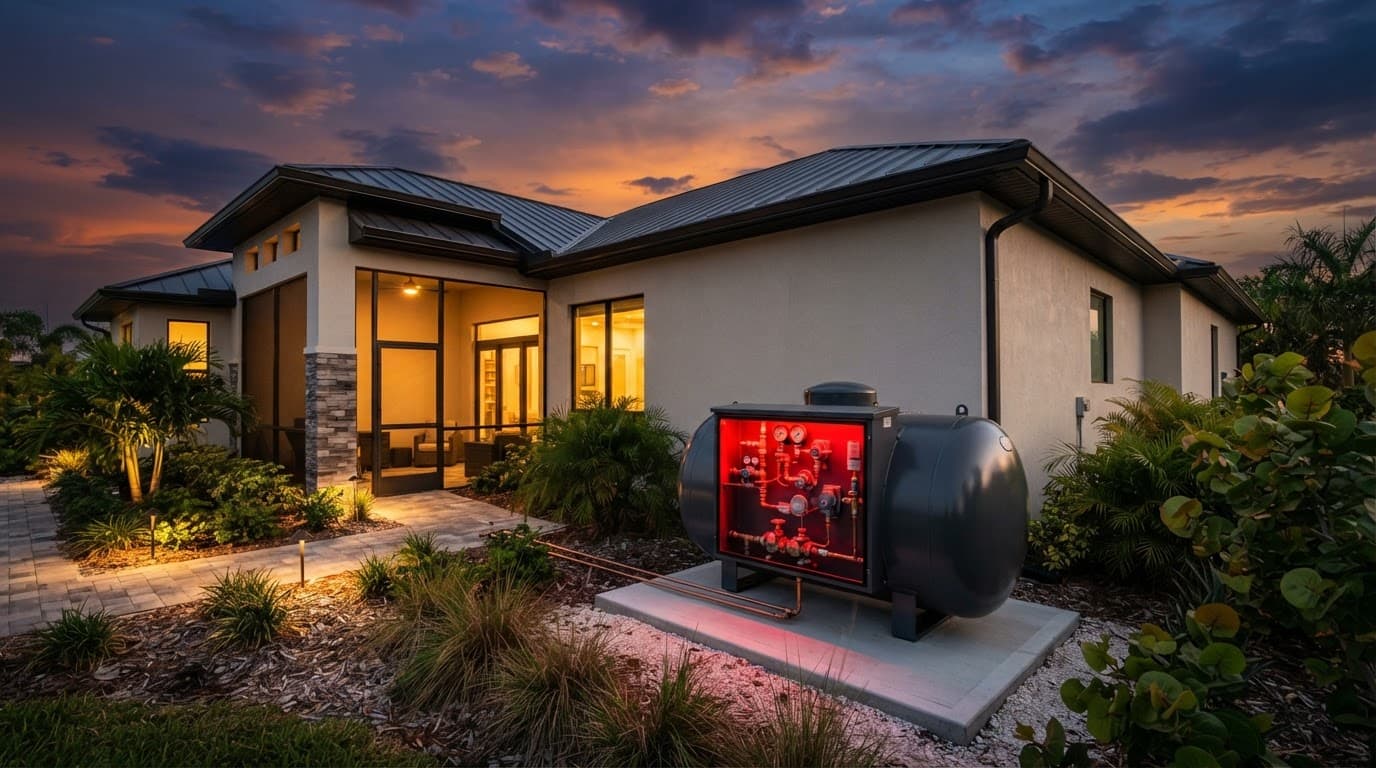
The main takeaway is straightforward: size the propane tank by usable gallons and expected runtime, not by the number printed on the tank.
How to Calculate Propane Demand for a Standby Generator
The best tank-sizing process starts with the generator’s fuel consumption data and an estimate of the propane tank’s usable fuel.
Look for liquid propane consumption at different loads in the manufacturer’s specifications or installation manual.
A 20-kilowatt standby generator may use approximately 2.5 to 3 gallons per hour at an average load. At 100% load, consumption may rise to roughly 5 to 6 gallons per hour. The actual number varies by manufacturer, generator model, engine condition, fuel pressure, and electrical load.
We use the following process when reviewing a system.
1. Check the generator’s propane consumption
Find the fuel rate at 50% load and full load. If the manual lists BTU per hour instead of gallons per hour, propane contains approximately 91,690 BTUs per gallon.
Have a propane professional verify the conversion, fuel pressure, and manufacturer data when the manual lists BTU per hour.
The basic conversion is:
Total BTU demand per hour / 91,690 = approximate gallons per hour
Fuel consumption at 100% load is useful for gas piping and supply calculations. Runtime planning usually uses the expected operating load, but we also leave room for startup surges and periods of heavy air-conditioning demand.
2. Estimate the outage runtime
Runtime depends on tank size, generator load, and consumption rate. Fuel volume alone doesn’t determine runtime.
Use this formula:
Usable propane gallons / generator gallons per hour = approximate runtime
The usable-gallon estimate reflects the safe fill limit, generally 80% capacity, rather than the tank’s listed volume.
For example, a 250-gallon tank provides about 200 usable gallons. At 2.5 to 3 gallons per hour, it could provide about 67 to 80 hours at the expected load.
That equals roughly three days, assuming the generator runs at that average load and the tank starts full. Running the generator at full capacity would reduce the runtime substantially.
3. Account for connected appliances
A standby generator may power the entire electrical panel. That doesn’t mean every large appliance should run at the same time, so review propane appliances alongside electrical loads.
Common loads include:
- Central air conditioners and heat pumps
- Pool pumps and pool heaters
- Electric water heaters
- Refrigerators and freezers
- Well pumps and septic pumps
- Electric ranges and clothes dryers
- Sump pumps and drainage equipment
- Medical devices and home office equipment
- Electric vehicle chargers
Some systems use load management equipment to delay or disconnect selected loads when demand rises. This can reduce generator strain and control fuel consumption. However, load management doesn’t eliminate the need for correct generator and tank sizing.
A propane water heater, range, dryer, fireplace, or pool heater connected to the same tank also uses fuel. A pool heater can consume a large amount of propane in a short period, so we always ask whether it will run during an extended outage.
4. Build in a propane delivery reserve
We don’t recommend planning to use every available gallon before scheduling a refill. Storm delays can slow deliveries, and a tank gauge isn’t a perfect measurement of the fuel remaining inside.
A reasonable plan includes a refill trigger before the tank becomes critically low. The exact trigger depends on the supplier, property access, seasonal demand, and expected weather. The goal is to have fuel available while routes are still open.
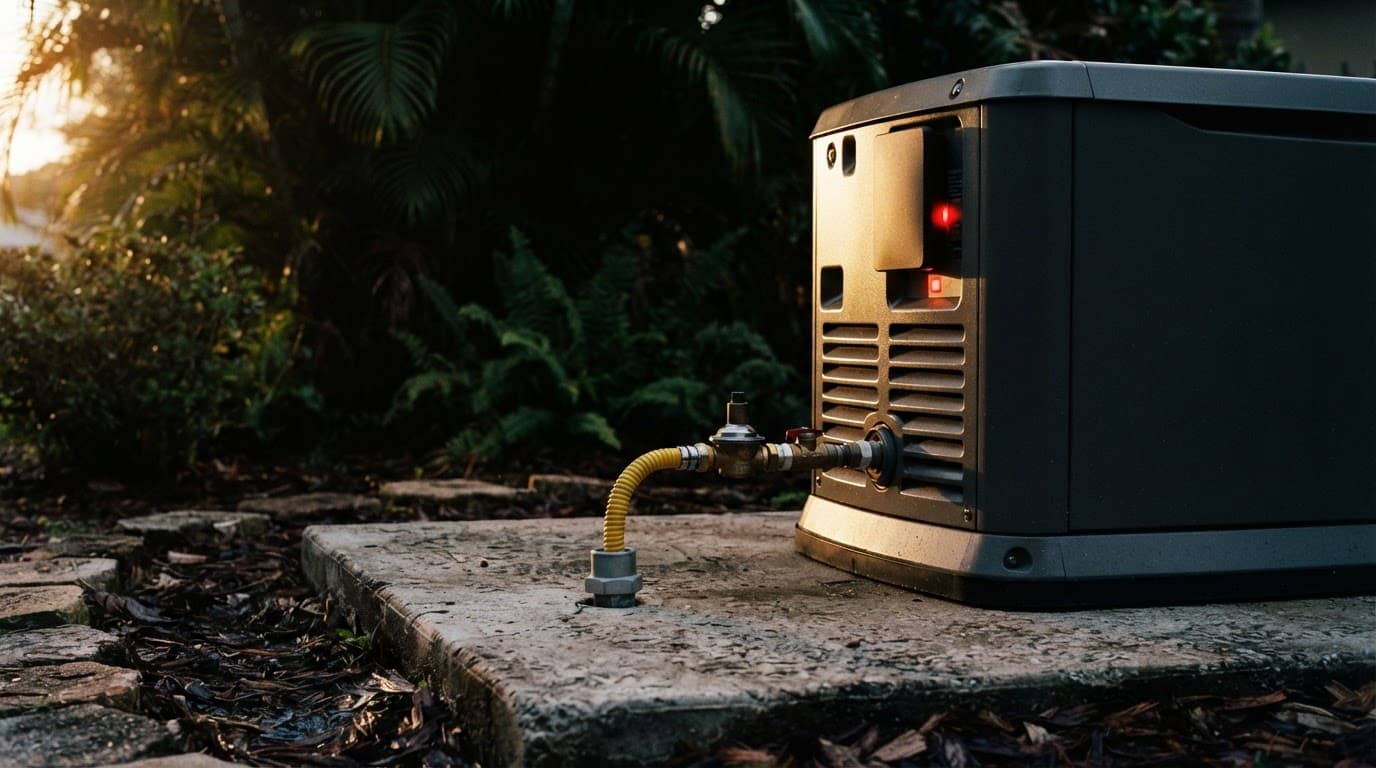
A practical runtime example
The following estimates use a 20-kilowatt generator consuming about 2.5 to 3 gallons per hour at an average load.
| Listed volume | Usable gallons | Approximate runtime at average load |
|---|---|---|
| 250 gallons | 200 gallons | 67 to 80 hours |
| 500 gallons | 400 gallons | 133 to 160 hours |
| 1,000 gallons | 800 gallons | 267 to 320 hours |
These are planning estimates, not guarantees. A generator running multiple air conditioners, pool equipment, or electric heating elements may consume fuel faster. A lightly loaded generator may run longer.
Choosing Among Propane Tank Sizes
The right tank size depends on the home, generator, appliances, property layout, and expected recovery time. There isn’t one tank that fits every Florida property.
When a 250 gallon propane tank may work
This tank provides about 200 gallons of usable propane. It may be appropriate for a smaller home, a lower-capacity generator, or a system designed to run selected loads rather than the entire home.
It can also be a practical choice when propane is used only for the generator and reliable propane delivery is available. At an average consumption of 2.5 to 3 gallons per hour, a 20-kilowatt generator could run for about three days under moderate load.
However, 250 gallons is often a starting point rather than a long-outage solution. If your home has multiple air conditioners, a pool heater, or a large electrical load, the tank may not provide the duration you expect.
When a 500 gallon propane tank makes sense
The 500-gallon model holds about 400 usable gallons. It is a common residential choice for whole-home standby systems in the 22 to 28-kilowatt range.
For many Southwest Florida homes, this model offers a useful balance between fuel storage, installation space, delivery needs, and outage protection. Depending on the load, it may provide several days of operation during a hurricane-related outage.
This model may support the generator, refrigeration, air conditioning, water systems, and selected household appliances. It may not provide the same runtime if a pool heater or other high-consumption appliance operates continuously.
When a 1000 gallon propane tank is the better option
This option provides approximately 800 usable gallons. It is often considered for large homes, properties with high electrical demand, rural locations, or homeowners who want more time between deliveries.
It can be a better choice when the home has multiple cooling zones, several major appliances, or a generator that regularly carries a heavy load. It also provides more fuel flexibility when roads, suppliers, or delivery schedules may be affected after a major storm.
A larger propane tank requires more space and greater setbacks. The property must support the installation, delivery truck access, underground utilities, and local approval requirements.
For most homeowners, the decision comes down to outage tolerance. A 250-gallon model may cover a shorter interruption. A 500-gallon model is often a practical whole-home choice. A 1,000-gallon model provides additional fuel security when extended outages are a serious concern.
Propane Tank Dimensions and Property Space
Tank size affects the available footprint, required setbacks, service access, and delivery access. A propane tank also needs room for connections and inspections. Underground propane tanks may require different access and excavation requirements.
A typical 500-gallon model may measure approximately 3 feet in diameter and 10 feet long. Some models use a larger diameter and shorter length, such as about 3 feet 6 inches in diameter and 7 feet 9 inches long.
A typical larger model, often around 1,000 gallons, may measure approximately 3 feet 6 inches in diameter and 16 feet 8 inches long. Manufacturer dimensions vary, and the installation needs more than the tank’s footprint. Technicians need access for connections, inspection, maintenance, and propane delivery.
The property plan must account for:
- Distance from the home and other structures
- Property lines and ignition sources
- Electrical equipment and generator placement
- Driveway and propane delivery truck access
- Overhead obstructions and underground utilities
- Drainage, flood exposure, and soil conditions
- HOA or community appearance requirements
A propane professional should verify the manufacturer’s dimensions, clearances, utility locations, and delivery path before selecting a location.
A larger tank can also change the location of the generator. The tank and generator don’t always sit directly next to each other, but the fuel line must be properly sized and protected.
Above Ground Propane Tanks Versus Underground Propane Tanks
Above-ground tanks are easier to inspect, service, and visually monitor. A delivery driver or technician can see the tank, valves, regulator, and surrounding area. This visibility simplifies tank maintenance and helps identify corrosion, damage, or landscaping problems.
The tradeoff is visibility. These tanks take up yard space and may be subject to HOA screening requirements. They are also more exposed to windborne debris, lawn equipment, salt air, and standing water.
Underground propane tanks preserve more of the yard’s appearance and reduce visible equipment. They can also provide protection from some surface-level impacts. However, placing the propane tank underground requires excavation, careful backfill, corrosion protection, drainage planning, and access to service components.
Florida’s heavy rain and saturated soil create additional planning concerns. An underground location must be reviewed for water movement, flood exposure, and possible soil shifting. A tank should never be buried without following the manufacturer’s instructions, safety procedures, and local code.
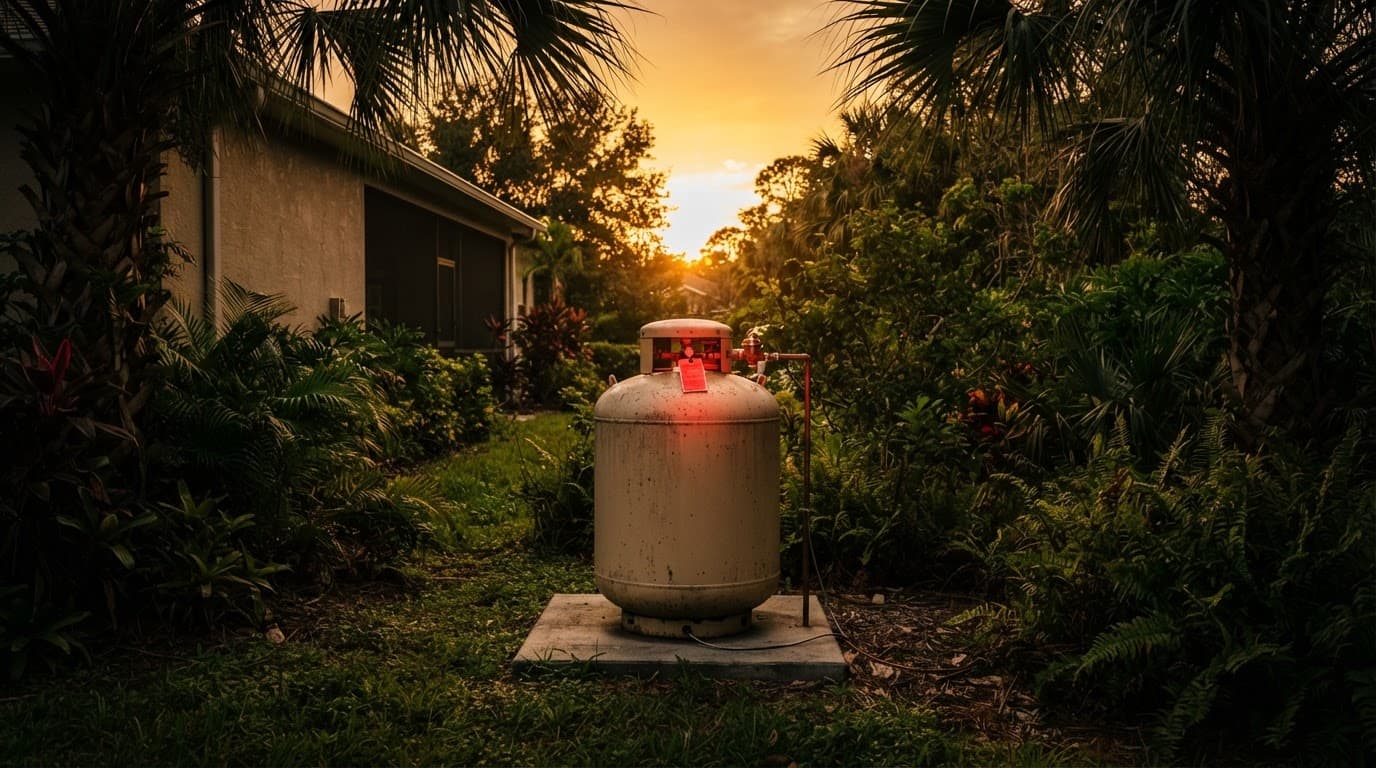
Common planning guidance places 125- to 500-gallon tanks about 10 feet from buildings, property lines, and ignition sources. Tanks between 501 and 2,000 gallons may require approximately 25 feet of separation. The required distance can change based on the tank, location, installation type, and local authority.
We review the site before recommending aboveground or underground placement. A location that looks convenient on a property survey may limit propane delivery access or interfere with drainage, utility lines, and generator service.
How Florida Climate and Outages Affect Tank Size
Southwest Florida’s local climate changes how homeowners should plan fuel. The tank size should reflect cooling demand, outage patterns, storm exposure, and possible delivery delays.
During a hot-weather outage, air conditioners may run for long periods. The generator can also power pool pumps, refrigerators, freezers, water systems, and ventilation equipment. If a home uses propane appliances for water heating, cooking, or pool heating, those appliances add to the same fuel demand.
Coastal properties face another concern. Salt air and moisture can increase corrosion on exposed metal, electrical connections, battery terminals, and fuel system components. Heavy rain can also create drainage problems around the generator or tank.
Home heating demand is usually not the main concern in Florida, and whole house heating rarely drives fuel planning. We review the actual electrical loads and plan for the outage conditions most likely to affect the property.
For a home near the Gulf Coast or Atlantic Coast, a larger propane tank may be reasonable when the homeowner wants several days of additional fuel. Rural properties may also benefit from more fuel on site if delivery access is limited or refill scheduling is less convenient.
Installation and Maintenance Protect the Fuel Plan
The propane tank and gas piping must support the full rated demand of backup generators, not only their normal average load. An undersized gas line, poor regulator setup, blocked airflow, or improper placement can still cause performance problems.
Professional installation also accounts for permits, electrical connections, transfer switch operation, tank clearance, grounding, ventilation, and access for service. Our whole-house generator installation process includes these planning details before the equipment is installed.
Routine tank maintenance and generator servicing matter just as much after installation. Florida heat, humidity, rain, insects, rodents, and salt air can affect outdoor equipment. Annual service should include oil and filter service, battery testing, cable inspection, corrosion checks, regulator or valve inspection, air intake review, spark plug service when required, and an automatic exercise-cycle test.
Heavy generator use after a hurricane may shorten the next service interval. Keep installation documents, permits, tank information, service invoices, and repair records together. These records help technicians identify problems and can support warranty or insurance questions.
Homeowners insurance usually doesn’t cover routine maintenance, fuel, normal wear, an old battery, or a mechanical failure that happens without a covered event. Wind, lightning, fire, theft, or certain surge losses may be treated differently, depending on the policy, deductible, and endorsements. A service record helps show how the equipment was maintained and what caused the damage.
If you are planning a system in Fort Myers, Naples, Cape Coral, Lehigh Acres, Bonita Springs, or a nearby community, Get a Free Consultation before ordering the tank. A site review can prevent setbacks caused by limited space, poor access, or an incorrect fuel plan.
Frequently Asked Questions
How do I calculate propane tank runtime for a standby generator?
Divide the tank’s usable propane gallons by the generator’s gallons-per-hour consumption. For example, 200 usable gallons divided by 2.5 to 3 gallons per hour provides approximately 67 to 80 hours at an average load.
Is a 250-gallon propane tank enough for a whole-home generator?
A 250-gallon tank may work for a smaller home, lower-capacity generator, or system designed to power selected loads. It may not provide the desired runtime when multiple air conditioners, pool equipment, or other high-consumption appliances operate during an extended outage.
What propane tank size is common for a Southwest Florida home?
A 500-gallon tank is often a practical starting point for a whole-home standby system because it provides about 400 usable gallons. The right choice still depends on generator size, electrical loads, property space, and the length of outage the homeowner wants to cover.
Should I choose an above-ground or underground propane tank?
Above-ground tanks are easier to inspect and service, while underground tanks preserve more of the property’s appearance. The decision should account for drainage, flood exposure, corrosion protection, delivery access, local requirements, and future service needs.
Why should I keep a propane delivery reserve?
Storm damage can delay propane deliveries, even when fuel is available from the supplier. Scheduling a refill before the tank becomes critically low helps maintain fuel availability while roads and delivery routes are still accessible.
Conclusion
The propane tank plan should begin with generator fuel consumption, real electrical loads, and the desired outage duration. A 250-gallon model may provide about 200 usable gallons, while a 500-gallon model provides about 400, and a 1,000-gallon model provides about 800.
For many Southwest Florida homes, 500 gallons is a practical whole-home starting point. Larger homes, higher loads, rural properties, and longer hurricane outages may justify 1,000 gallons. The final choice should also account for placement, delivery access, local clearances, gas piping, and routine service.
A standby generator is only as dependable as the fuel plan supporting it. The right plan gives your home more time when the next outage lasts longer than expected.