


When a power outage occurs in Southwest Florida, we do not get to choose the timing. We only get to choose the backup power plan that keeps us safe.
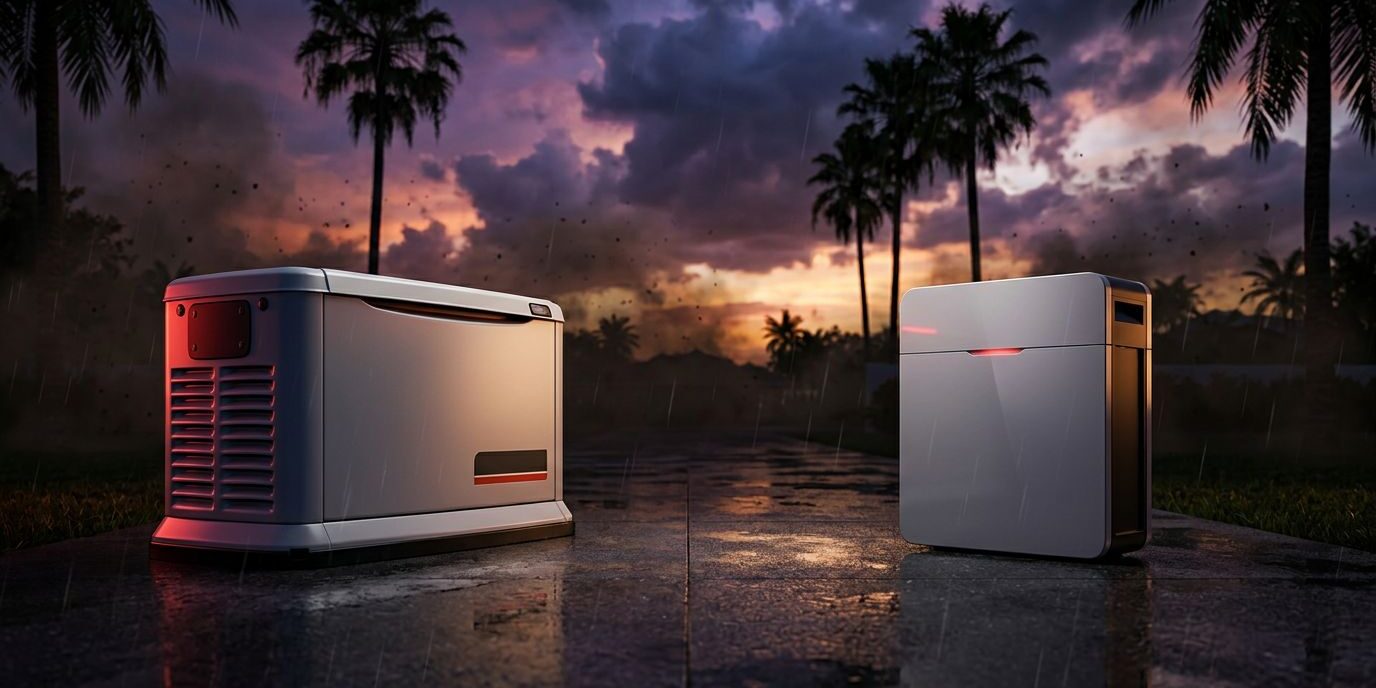
That is where the real generator vs battery backup question starts. One option runs on fuel and keeps going through long outages. The other is quiet, clean, and fast to kick in. Both can save a rough week, but they do it in very different ways.
If we live here long enough, we learn one simple truth, hurricane season does not care what looks neat on paper. It cares what works when the lights go out.
Key Takeaways
- Duration and Load: Standby generators are designed for long-term endurance and heavy-load demands like air conditioning, while batteries are best suited for shorter durations and essential, lower-power appliances.
- Operational Differences: Generators provide constant power through fuel sources but require regular mechanical maintenance; batteries offer silent, instantaneous, and near-maintenance-free operation.
- Environmental Factors: In Florida, the extended nature of hurricane-related outages often makes the fuel-based reliability of a standby generator the more practical choice for full home coverage.
- Site Considerations: Batteries are often better for HOA-regulated neighborhoods due to their silent operation and compact size, whereas generators require careful placement for exhaust safety and sound management.
How a standby generator and a home battery work
A standby generator is the heavier player in the backup market. It sits outside, watches the grid, and starts on its own when power fails. Most systems come on in seconds, then keep the house running as long as fuel keeps flowing, making a standby generator a reliable choice for extended outages.
For many homes, that means a whole-home standby generator can cover the big stuff, like the air conditioner, refrigerator, lights, security system, and even a well pump if the setup is right. It is built for long runs, not short stints.
A home battery backup works differently. It stores power and releases it the moment the grid drops. There is no engine noise, no exhaust, and no fuel tank. It feels almost like nothing happened, which is the whole point of this type of backup power.
The catch is runtime. A battery can keep essential appliances on for hours, sometimes longer if the load is small. If you have solar panels installed, they can help recharge the system during the day to extend your reach. However, a battery is a tank, not a faucet. Once it empties, it is empty.
Florida weather changes the answer fast
In a mild climate, a battery backup gets a stronger argument. In Florida, storms change the math.
We do not plan around a 20-minute outage. We plan around downed lines, flooded streets, utility delays, and the fact that grid electricity may be unavailable for days during a severe power outage. That is where a generator starts to look less like a luxury and more like a long-haul tool.
Quiet is great. Cold food, working AC, and live internet matter more when the outage runs long.
Heat matters too. So does humidity, salt air, and the way summer storms seem to arrive with no warning at all. Effective energy storage performs better in the heat than many people expect, but these systems still have limits. Generators also need care in this climate, because batteries, cables, and charging systems can wear faster here than they do inland.
Battery backup makes a lot of sense when we want instant power, low noise, and a clean setup. That is especially true in tighter neighborhoods, smaller lots, or HOAs that pay close attention to what sits in the yard. A generator can work there too, but placement, screening, sound, and fuel planning become part of the story.
For Florida homeowners, the question is not which one is nicer. It is which one still works when the backup duration exceeds initial expectations.
The real tradeoffs: noise, fuel, cost, and maintenance
This is where the conversation usually gets honest. We can talk about specs all day, but the daily tradeoffs are what people remember when a power outage strikes.
| Factor | Standby generator | Home battery backup |
|---|---|---|
| Start-up | Automatic, via transfer switch | Near-instant |
| Runtime | Can run for days with fuel | Limited by stored power |
| Big loads | Better for AC, pumps, and whole-home use | Better for essentials and smaller loads |
| Noise | Audible outside the home | Nearly silent |
| Exhaust | Yes, so placement matters | None |
| Maintenance | Regular service required | Minimal, mostly monitoring |
| Upfront cost | Often lower for whole-home coverage | Often higher for whole-home coverage |
The table highlights the key differences. A generator offers superior endurance, while a battery excels in providing a quiet, instant response. Unlike a portable generator, which requires manual setup and refueling during a storm, a standby system is permanently installed and ready to engage automatically through a transfer switch.
When considering fuel sources, standby generators offer flexibility by running on either natural gas or liquid propane. However, owners must be aware that because these units produce exhaust, carbon monoxide safety is a critical factor, and placement must always be well away from windows and air intakes.
Maintenance is where many homeowners are surprised. A standby generator requires more than just fuel; it needs regular oil changes, spark plugs, filter replacements, and a technician to verify the system health. While these generate predictable maintenance costs, they ensure the unit is ready when needed. Neglecting these tasks can lead to higher operating costs later if a component fails during an emergency. If we only check the unit when storm season is near, we are already behind.
That is why generator service and maintenance matters so much. A system can look perfect from the outside and still fail to start if the internal battery is weak or the charging circuit is faulty. Florida heat and humidity do not help matters, as they place extra stress on electrical components.
Battery systems generally ask for less hands-on care, but they are not maintenance-free. Batteries age over time, and software monitoring is essential to ensure longevity. Furthermore, if you want a battery system to power more than just a few essential circuits, the total investment climbs quickly.
Which setup fits which kind of home
There is no one-size answer here. There are only better fits.
If we want to keep the house running through an extended power outage, a standby generator usually wins. If we need the AC, the fridge, the internet, and the security system to stay on, a whole-home backup solution powered by fuel still has the edge in endurance.
If our outages are shorter, or we care most about silence and clean operation, a battery backup may fit better. These systems are a strong choice for homes where the load is lighter, the lot is tight, or the neighborhood does not love the sound of a generator. A popular option is the Tesla Powerwall, which integrates seamlessly into a solar-plus-storage setup to capture clean energy.
A few common situations usually point us in one direction:
- Long hurricane outages: standby generator
- Quiet HOA communities: home battery backup
- Homes with large AC loads: standby generator
- Homes with solar and modest backup needs: battery backup
- Families who want hands-off endurance: standby generator
- Owners who want silent, indoor-style backup behavior: battery backup
Permits, inspections, and layout also matter. Generator installs usually involve gas line work, pad placement, setbacks, flood considerations, and coordination with electricians or fuel providers. While battery installation costs can be significant, owners may offset this via the federal tax credit. Furthermore, batteries help with utility bill savings by allowing homeowners to manage time-of-use rates effectively.
Batteries are generally simpler on the outside, making them easier to fit into a smaller property. To optimize performance, we can add an energy management system that intelligently shifts power usage. As technology evolves, many battery owners are also exploring the benefits of a virtual power plant, which allows them to contribute stored energy back to the grid during peak demand.
If we want help sorting all of that out, we can start with a free consultation. The right answer usually gets clearer once someone looks at the load, the lot, and the way we actually live.
Frequently Asked Questions
Which option is better for a total power outage lasting several days?
A standby generator is the superior choice for long-duration outages. Because it runs on natural gas or propane, it provides a consistent, reliable energy supply as long as fuel is available, which is essential when grid repairs take time.
Can a home battery be used instead of a generator in Florida?
Yes, but with limitations. A battery is an excellent solution for short-term outages and provides quiet, instant power, but it will eventually run out of stored energy unless supplemented by a solar array or limited to essential loads only.
How much maintenance does a standby generator require?
Standby generators require regular, professional maintenance to ensure reliability, including oil changes, filter replacements, and spark plug checks. Neglecting this maintenance can lead to mechanical failure at the exact moment you need the power most.
Does a battery backup system make sense if I have solar panels?
Absolutely, as solar panels can recharge your battery system during the day to extend your runtime significantly. This combination provides a cleaner, renewable way to maintain power during outages compared to relying solely on fossil fuels.
The Bottom Line for Florida Homes
A standby generator is the superior tool for long outages, heavy electrical loads, and the harsh realities of storm season. Conversely, a home battery backup is the better fit for quiet operation, instant response, and lighter backup needs.
For most Southwest Florida homes, the decision comes down to one question: do we want a system that runs for hours, or one that can keep going for days? Once we answer that honestly, the choice between relying on grid electricity or independent power gets much simpler.
Whether you choose the long-term reliability of a standby generator or the silent efficiency of a modern battery, the goal remains the same. We all want dependable backup power that shows up exactly when the sky turns ugly and the local infrastructure fails. By investing in the right backup power solution, you can ensure your family stays safe and comfortable during any unexpected power outage.